Securities Services

We draft private placement memoranda for Reg D sponsors.

Flat-fee PPM drafting for Reg D 506(b) and 506(c) offerings. Nationwide representation under federal preemption. Most offerings launch in weeks, not months.

or call (949) 570-1507

1000+

offerings
drafted

$8B+

capital raised through
our clients

50+

combined years of
legal experience

What's in your offering package.

A PPM doesn't ship alone. We draft the full document set your offering needs to launch and stay compliant.

Private Placement Memorandum (PPM)

The full offering disclosure: deal structure, sponsor background, risk factors, use of proceeds, and securities terms. Drafted to satisfy Reg D anti-fraud requirements and stand up to investor scrutiny.

Operating Agreement

The governing document for your fund or syndication entity. Spells out distributions, voting rights, capital calls, removal provisions, and the economic relationship between sponsors and investors.

Subscription Agreement and Investor Questionnaire

The contract investors sign to buy in, paired with the accredited or sophisticated investor verification framework that satisfies your chosen Reg D exemption.

Form D and state notice filings

Federal Form D filed with the SEC plus blue-sky notice filings in every state where you have investors. We track the filing windows; you provide the investor list as the raise progresses.

What belongs in your PPM.

A PPM is a disclosure document, not a marketing brochure. The sections below cover what your investors and the SEC expect to see in a Reg D offering.

  • Executive summary. The deal at a glance: who's raising, how much, what they're buying, what investors get.
  • The sponsor. Background, track record, principal bios, related-party affiliations.
  • The offering. Securities offered, minimum and maximum raise, minimum investment, use of proceeds.
  • The investment. Distribution waterfall, preferred returns, promote structure, capital call mechanics.
  • The property or business. Asset description, market analysis, business plan, projected sources and uses.
  • Management. Who runs the deal day to day, manager compensation, removal provisions, conflicts of interest.
  • Risk factors. Asset-specific, structural, market, regulatory, and sponsor-related risks that could impair investor returns.
  • Tax treatment of the investment. How the deal flows through to investors at tax time, including reporting and timing considerations.
  • Investor reporting and communications. Distribution timing, financial statements, annual reports, and how sponsors keep investors informed through the life of the deal.
  • Securities law disclosures. Reg D reliance, accredited investor verification, resale restrictions, no-action and bad-actor representations.
  • Subscription procedures. How investors commit, when the offering closes, escrow and minimum-raise contingencies.
  • Exhibits. Operating agreement, subscription agreement, investor questionnaire, financial projections, market reports.

How the offering comes together.

From first call to first investor, most Reg D offerings take three to four weeks. Here's what each phase looks like.

1
Day 1

Intake call

A free thirty-minute call to scope the offering: asset class, raise size, exemption, investor pool, timing. By the end, you know whether we're the right fit and what the flat-fee quote will be.

2
Week 1

Engagement and the Deal Structure Interview

Engagement letter signed. We then schedule the Deal Structure Interview, a working call where we walk through the deal together: structure, waterfall, sponsor compensation, investor terms, and disclosures. Sponsors who haven't worked out every detail leave the call with homework, specific items to research or decide before drafting begins. This is why some clients call it the "homework call."

3
Weeks 1-3

Drafting

We draft the full package: PPM, operating agreement, subscription agreement, and investor questionnaire. First draft delivered for your review with a short call to walk through the major decisions.

4
Week 3

Review and finalization

Revision rounds based on your input, your CPA's input, and any sponsor-side review. We finalize the document set when you're ready to launch.

5
Week 4
and beyond

Launch and filings

You start accepting subscriptions. We file Form D with the SEC within fifteen days of your first sale and file state notice filings as your investor list develops. Post-launch counsel is included for six months at no additional charge.

Most offerings ship in weeks. Complex structures take longer; we'll tell you up front if yours does.

How our fees work.

Every PPM engagement is flat-fee.
Your quote depends on your maximum offering size, not on how many hours we end up putting in.

Tier One

Up to $2.5M

Single-asset syndications, small funds, and friends-and-family raises with a maximum offering size of $2.5 million or less.

Tier Two

Over $2.5M

Larger syndications, mid-sized funds, and institutional-track offerings with a maximum offering size above $2.5 million.

Included

Full offering package

PPM, operating agreement, subscription agreement, investor questionnaire, Form D filing, state notice filings, and six months of post-launch counsel. We also review your investor-facing marketing materials for compliance with your chosen exemption.

What we invoice separately

State notice filing fees and any entity formation costs are pass-through expenses. We advance these costs and invoice them to you at our cost; we never mark them up.

Free consultation. Flat-fee quote delivered on the call.

Why sponsors choose us.

Three reasons sponsors come to us for their PPMs:
the author of the essential book on syndication leads the firm, the team covers every U.S. time zone, and our flat-fee structure means no billing surprises.

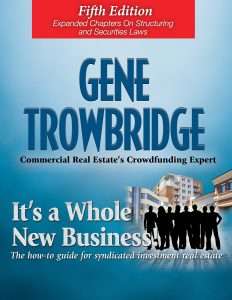
It's a Whole New Business! by Gene Trowbridge, 5th Edition
#1 BESTSELLER

#1 Best Seller, SECURITIES LAW & CROWDFUNDING

Gene Trowbridge wrote the book on syndication.

Now in its 5th edition, It's a Whole New Business! is the field guide for sponsors raising private capital. Used by syndicators, brokers, and other attorneys.

Nationwide securities representation

Reg D offerings are governed by federal law, which preempts state-level licensing for securities work. Our team practices across multiple time zones, so your offering gets attention from the first call of the East Coast morning through the last review of the Pacific evening.

Flat fees, not hourly surprises

Every PPM engagement is quoted as a flat fee tied to your maximum offering size. You know the cost before we start drafting and the number doesn't change as the work progresses.

Recent PPMs we've drafted.

A sample of anonymized matters from the firm's offering work. Specifics on sponsors, entities, and addresses are omitted; the editorial details that matter are kept.

preferred return fund of funds representative matter
Fund of Funds

Structuring a preferred equity fund of funds under 506(c)

The fund did not own real estate. It pooled accredited capital to take a preferred equity position in the capital stack of a ground-up multifamily development, which meant the disclosure had to explain a layered structure rather than a direct property purchase, and the offering relied on public verification under 506(c).

Multifamily
2026

Common questions about PPM drafting

Questions sponsors ask us most often before signing an engagement letter.

Templates exist for nearly every Reg D situation, and a few are even reasonably drafted. The problem is that a PPM is built around the specific facts of your deal: your sponsor background, your asset, your waterfall, your risk factors, your jurisdiction mix. A template that doesn't reflect those facts isn't a disclosure document, it's a liability. Reg D's anti-fraud provisions apply regardless of whether your offering is registered, and an inadequate PPM is the most common evidence in investor disputes. Paying for a proper PPM is meaningfully cheaper than defending the lack of one.

Most offerings ship in three to four weeks from engagement to launch. Complex structures (multi-asset funds, blind pools, cross-border investors, unusual waterfalls) can take longer. We'll tell you up front during the intake call if your deal falls into the longer category.

Both are exemptions under Regulation D and let you raise unlimited capital from accredited investors without registering the offering with the SEC. The difference is in how you find investors.

Rule 506(b): No general solicitation. You can only offer the securities to people you have a pre-existing substantive relationship with. You can include up to 35 sophisticated non-accredited investors, but the disclosure requirements get heavier when you do.

Rule 506(c): General solicitation is allowed. You can advertise the offering publicly, post it online, and pitch it to people you don't know. The trade-off is that every investor must be accredited and you must take reasonable steps to verify their accreditation status. Self-certification is not enough.

The choice depends on whether you have an existing investor network (lean 506(b)) or want to market the deal publicly (lean 506(c)).

That's what the Deal Structure Interview is for. We walk through the deal together: structure, waterfall, sponsor compensation, distribution mechanics, and disclosures. Sponsors who haven't worked out every detail leave the call with specific homework, items to research or decide before drafting begins. Most clients sharpen their deal during this call, not before it.

The full document package (PPM, operating agreement or LP agreement, subscription agreement, investor questionnaire), federal Form D filing, state notice filings as your investor list develops, and six months of post-launch counsel. We also review your investor-facing marketing materials for compliance with your chosen exemption. The flat fee is tied to your maximum offering size, not to how many hours we spend.

State notice filing fees are pass-through expenses paid to each state where you have investors. Entity formation costs (state filing fees, registered agent fees) are also pass-through if you need a new entity. We advance these costs and invoice them to you at our actual cost; we never mark them up. Anything outside the standard offering package (SEC registration, REIT structuring, securities litigation defense, ongoing fund counsel beyond the six-month window) is quoted separately.

Yes. The most common scenario: a 506(b) offering filed against an existing investor base that doesn't fully subscribe, where the sponsor needs to switch to 506(c) and use general solicitation to find the remaining capital. We draft PPMs that contemplate this transition from the start with appropriate disclosure language, integration safe-harbor analysis, sequencing of subscriber communications, and the accredited-investor verification mechanics that come online with 506(c). Sponsors who anticipate this possibility get more flexibility than a single-exemption PPM provides; sponsors who realize the need mid-raise can also retain us for the amendment work.

Ready to raise capital? Let's talk.

Free consultation. No obligation. Flat-fee quote delivered after the call.